
Table of Contents
- Why Structured Puppy Training Works Best: The Core Difference
- Building a Puppy Training Schedule That Fits Your Day
- How Long Should Each Puppy Training Session Length Be?
- Positive Reinforcement Puppy Training: Why Rewards Beat Corrections
- Puppy Group Classes vs Private Training: Which Fits Your Puppy?
- The 8-16 Week Window: Why Early Structure Matters Most
- Frequently Asked Questions
Last Updated: October 8, 2026
Why Structured Puppy Training Works Best: The Core Difference
Most puppy owners fail at training not because they lack effort, but because they lack a plan. Structured puppy training replaces guesswork with a repeatable daily system, which is why it outperforms random training sessions. In this guide from RAK GROUP, we break down the schedule, session length, and reinforcement methods that make structure the deciding factor.
The evidence backs this up. Researchers cited by TIME's reporting on the science of dog training found that dogs from positive-training schools performed better on presented tasks than dogs from aversive-training schools. Same dogs, same tasks, different method.
So what separates a structured plan from simply "training a lot"? Consistency and sequence. A structured plan tells you what to do today, not just what to do eventually.
Below, we'll show you exactly how to build that plan around your real schedule, how long each session should run, and which training format fits your puppy.
How Structure Differs from Cramming Commands
Cramming means running through sit, stay, down, and come in one long, chaotic block. Structure means splitting those skills across short, timed sessions with a clear goal for each one.
The difference shows up in retention. A puppy that practices "sit" for three focused minutes, three times a day, learns faster than one drilled for twenty minutes once.
Structure also protects your sanity. You stop wondering whether you're doing enough, because the plan already answers that.
Building a Puppy Training Schedule That Fits Your Day
A workable puppy training schedule anchors training to moments that already happen: before meals, after potty breaks, and before bed. You are not adding new appointments to your day. You are attaching training to routines you already keep.
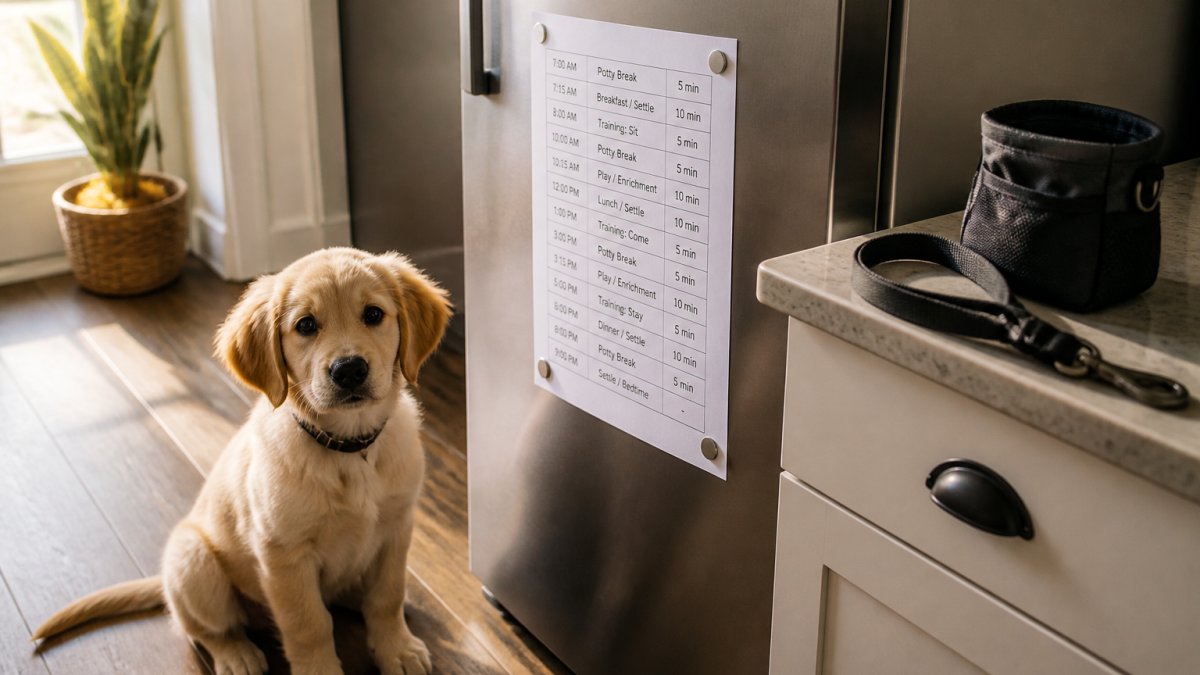
Start with three short blocks per day. Morning, midday, and evening work for most households.
Keep each block focused on one skill. Monday morning is "sit." Monday evening is "name recognition." Tuesday morning is "come."
New puppy owners who want this mapped out day by day can use our 14 Day Puppy Potty Training Bootcamp, a $19.99 instant PDF download with potty schedules built around your routine.

A Sample Daily Rhythm for a Young Puppy
- 7:00 a.m., Potty break, then 3 minutes of "sit" practice before breakfast
- 12:00 p.m., Potty break, then 2 minutes of name recognition
- 5:30 p.m., Potty break, then 3 minutes of "come" in the hallway
- 8:00 p.m., Short walk, then calm settle practice on a mat
That is roughly 10 minutes of formal training per day. The rest of the day reinforces it.
How Long Should Each Puppy Training Session Length Be?
The ideal puppy training session length is 2 to 5 minutes for puppies under 16 weeks, repeated several times a day. Young puppies have short attention spans, and long sessions teach frustration instead of skills.
Here is how session length should scale as your puppy grows:
| Puppy Age | Session Length | Sessions Per Day | Focus |
|---|---|---|---|
| 8-10 weeks | 2-3 minutes | 4-5 | Name, potty cues |
| 11-14 weeks | 3-5 minutes | 3-4 | Sit, come, settle |
| 15-20 weeks | 5-8 minutes | 3 | Stay, leash manners |
| 5-6 months | 8-10 minutes | 2-3 | Distance, duration |
Stop every session while your puppy still wants more. That is the single best way to keep training something they look forward to.
Positive Reinforcement Puppy Training: Why Rewards Beat Corrections
Positive reinforcement puppy training works because it teaches your puppy what to do, not just what to avoid. A reward marks the exact behavior you want repeated, which is far clearer than a correction that only says "stop."
A 2026 PetWorks article notes that research has found reward-trained dogs show stronger obedience, fewer anxiety-related behaviors, and more durable results. That tracks with what trainers see in practice: punished puppies often shut down instead of learning.
14 Day Puppy Potty Training Bootcamp →
Rewards do not have to be treats. Praise, a toy, or a quick play break all count, as long as your puppy values them.
Puppy Group Classes vs Private Training: Which Fits Your Puppy?
Puppy group classes vs private training comes down to temperament and goals. Group classes build socialization and cost less per session. Private training targets specific problems faster.
Choose group classes if your puppy is confident, needs exposure to other dogs, and you want a set weekly structure.
Choose private training if your puppy is fearful, reactive, or you are working on one stubborn issue like leash pulling.
Here is the honest trade-off:
- Group classes: lower cost, built-in socialization, less individual attention
- Private training: higher cost, tailored pace, no peer distraction practice
Many owners do both. Group class for socialization, one or two private sessions for problem areas.
Recent guidance from Petmate's 2026 dog training guide frames the real goal as calm routines and clear communication rather than perfect obedience. A structured plan delivers both.
The 8-16 Week Window: Why Early Structure Matters Most
The 8-16 week window is the critical socialization period for long-term behavior, according to the American Kennel Club's puppy training timeline. What your puppy experiences in those weeks shapes how they react to people, sounds, and other animals for years.
That is why structure matters most early. A consistent routine during this window builds confidence. Chaos during it builds anxiety.
A 2026 paper on professional dog trainers' perspectives recommends structured discussion among trainers to keep methods grounded in research and ethics. The same principle applies at home: a plan you can review and adjust beats one you improvise.
If you are building that early routine now, start with the basics. Our 14 Day Puppy Potty Training Bootcamp gives you the day-by-day structure for the first two weeks, delivered as an instant PDF you can print or keep on your phone.
Frequently Asked Questions
Why is structured training important for puppies?
Structured training gives puppies a predictable rhythm they can learn from. The American Kennel Club identifies 8-16 weeks as a critical socialization period for long-term behavior, so what happens during that window matters. A structured puppy training approach pairs short, repeated sessions with consistent cues, which helps puppies connect actions to outcomes. Petmate's 2026 guide frames the goal as calm routines and clear communication, not perfect obedience. That consistency reduces stress for both the puppy and the owner.
How long should puppy training sessions be?
Keep sessions short and frequent rather than long and occasional. Young puppies have limited attention spans, so several brief sessions spread across the day work better than one extended block. End each session while your puppy is still engaged and successful, then follow with a reward. This is why a structured puppy training plan builds in multiple short practice windows instead of a single daily drill. If your puppy starts losing focus, the session has already run too long.
Are puppy group classes or private lessons better?
It depends on your puppy's temperament and your goals. Group classes offer controlled socialization with other puppies and distractions, which is valuable during the 8-16 week socialization window. Private training gives you tailored feedback and works well for puppies who are overwhelmed in group settings. Many owners use both: group classes for social exposure and private sessions for specific problem behaviors. The right choice depends on whether your priority is distraction-proofing or focused individual coaching.
How does consistency help with puppy training?
Consistency is what turns a command into a habit. When every family member uses the same cue, the same reward, and the same schedule, your puppy stops guessing and starts responding reliably. PetWorks reported in 2026 that reward-trained dogs show stronger obedience, fewer anxiety-related behaviors, and more durable results. A written puppy training schedule removes the daily decision-making and keeps everyone in the household aligned. Without consistency, even good training methods produce inconsistent results.
Puppy training fails most often when it is improvised, not when owners try hard enough. RAK GROUP builds the digital tools that remove the guesswork: a day-by-day potty training plan, printable schedules, and clear steps you can follow from day one. Get started with RAK GROUP and give your puppy the structured start that lasts.