
Table of Contents
- Why a Structured Schedule Matters for Working Owners
- Puppy Training Timeline by Age: What to Expect Each Stage
- How to House Train a Puppy Fast Around a Workday
- Building a Puppy Crate Training Schedule That Works
- Puppy Socialization Checklist for Busy Households
- Sample Daily Puppy Training Schedule for Working Professionals
- Budget-Friendly Professional Support and Emergency Planning
- Conclusion
- Frequently Asked Questions
Last Updated: September 30, 2026
Why a Structured Schedule Matters for Working Owners
A puppy training schedule for working professionals is a written, time-blocked plan assigning potty breaks, feeding, exercise, crate time, and short training sessions to specific points in your workday. Puppies learn through repetition, and repetition needs a rhythm you can keep.
Puppy Training Timeline by Age: What to Expect Each Stage
Age determines what your puppy can handle. Pushing skills too early creates frustration; waiting too long wastes the fastest learning period of your dog's life.
The Critical 8 to 16-Week Window
The 8 to 16-week developmental window is a 56-day period critical for establishing habits that last 15 years or more, according to Sit Means Sit puppy training guide. During this stretch, puppies absorb socialization and routine faster than at any other point.
Milestones from 4 Months to 1 Year
Between 4 and 6 months, bladder control improves enough for longer crate stretches. By 6 to 12 months, most puppies handle basic commands, leash manners, and command combinations.
How to House Train a Puppy Fast Around a Workday
The fastest route to house training is a fixed potty schedule, not more trips. Puppies succeed when they go out at predictable intervals, before accidents happen rather than after.
A workable baseline:
- Out immediately after waking
- Out after every meal, within 10 to 15 minutes
- Out after every nap and play session
- Out right before crate time
- One mid-day break, minimum, for puppies under 4 months
Potty Schedules That Fit Remote, Hybrid, and Office Schedules
Remote workers can take mid-morning and mid-afternoon breaks without leaving their desk for long. Hybrid workers should front-load potty trips on office days and lean on a dog walker or trusted neighbor for the gap. Full-time office workers need a mid-day visit arranged before the puppy comes home, not after the first accident.
Building a Puppy Crate Training Schedule That Works
A puppy crate training schedule introduces the crate in short, positive increments before asking for longer confinement. Rushing this step is the most common cause of crate resistance.
Crate Confinement vs. Exercise Pen Setups
Crates work for short, supervised rest periods. Exercise pens suit longer stretches when you need the puppy contained but still able to move, play, and reach a potty pad.
| Setup | Best For | Typical Duration | Watch Out For |
|---|---|---|---|
| Crate | Naps, feeding, short absences | 1-3 hours (age-dependent) | Overuse past bladder limits |
| Exercise pen | Work blocks, longer absences | 2-4 hours | Needs toys and a pad |
| Gated room | Older puppies, 5+ months | 3-4 hours | Puppy proofing required |
Puppy Socialization Checklist for Busy Households
Socialization is the deliberate, positive exposure of a puppy to new people, animals, sounds, surfaces, and environments during the developmental window. The goal is variety delivered calmly: a puppy who meets 20 people in one chaotic afternoon learns less than one who meets three calm strangers across three separate days.
The Weekly Socialization Quota
Aim for a repeatable weekly target rather than a one-time push:
- 3 new calm people per week, a neighbor, a delivery driver who agrees to pause, a friend on a weekend walk
- 2 new surfaces per week, grass, tile, gravel, wood, metal grate, a wobble board
- 2 new sounds per week, vacuum, blender, doorbell, thunder recording played low, traffic
- 1 car ride per week, even a five-minute loop to a quiet parking lot and back
- 1 vaccinated, puppy-tolerant adult dog per week, ideally one with a known, patient temperament
- Handling practice 3 times per week, paws, ears, mouth, tail, collar grab, in 30-second sessions
Fitting Socialization Into Remote, Hybrid, and Office Weeks
Most guides assume you have open daytime hours. Place exposures around the workday instead of on top of it.
What to Skip, and Why
Not every exposure is worth the risk. Skip dog parks until your puppy is fully vaccinated with reliable recall, crowded events, fireworks, and loud construction zones, those are flooding, not socialization. Skip unknown adult dogs on leash, especially in tight spaces where a bad interaction can set back weeks of work.
Socialization and Energy Level
High-energy working breeds and low-energy companion breeds need different pacing. A herding or sporting breed often needs more physical outlets layered on top of the exposure, a sniff walk counts as both. A toy or companion breed may tire faster and do better with shorter, more frequent exposures.
Sample Daily Puppy Training Schedule for Working Professionals
Most schedules online assume a 9-to-5 office job and a partner at home. Below are three templates, remote, hybrid, and rotating shift, plus rules for shifting any of them by an hour without breaking the puppy's rhythm.
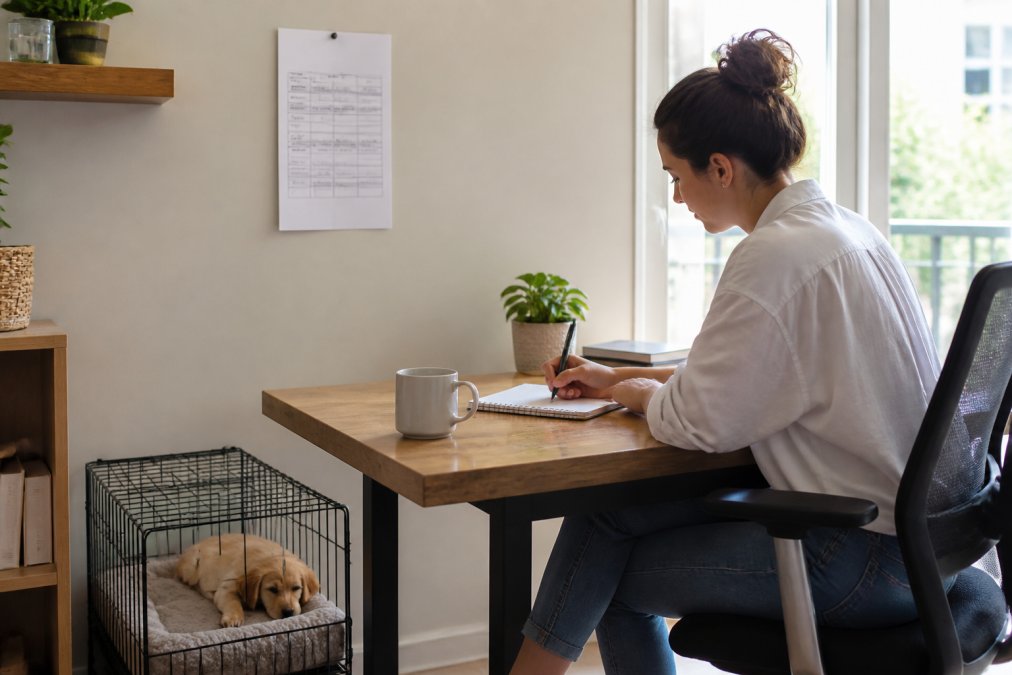
Template A: Fully Remote Workday
| Time | Block | What Happens |
|---|---|---|
| 6:30 a.m. | Wake + potty | Out immediately, before coffee |
| 6:45 a.m. | Feed | Measured meal, then 10 minutes of calm |
| 7:00 a.m. | Walk or play | 15 to 20 minutes of real exercise |
| 7:30 a.m. | Crate nap | Puppy down before your first meeting |
| 9:30 a.m. | Potty break | 5 minutes, back to crate or pen |
| 10:00 a.m. | Enrichment | Stuffed Kong or puzzle feeder in the pen |
| 12:00 p.m. | Lunch block | Potty + 5 to 10 minute training session |
| 12:30 p.m. | Crate nap | Longest rest of the day |
| 3:00 p.m. | Potty break | 5 minutes, brief play |
| 3:15 p.m. | Enrichment | Sniff mat or chew in the pen |
| 5:30 p.m. | End of workday | Potty, then 20 to 30 minute walk |
| 6:30 p.m. | Dinner | Feed, then settle |
| 7:30 p.m. | Training block | One skill, 10 minutes |
| 8:30 p.m. | Wind-down | Calm chew, lights low |
| 9:30 p.m. | Final potty | Out, then crate for the night |
Template B: Hybrid Week (3 Office Days, 2 Home Days)
On office days, the schedule compresses and the walker carries the middle. On home days, run Template A.
14 Day Puppy Potty Training Bootcamp →
Office day:
| Time | Block | What Happens |
|---|---|---|
| 6:00 a.m. | Wake + potty | Earlier than remote days |
| 6:15 a.m. | Feed | Then 15 minutes of exercise |
| 6:45 a.m. | Crate | Puppy down before you leave |
| 11:30 a.m. | Walker visit | Potty + 20 minute walk + one training cue |
| 4:30 p.m. | Return home | Potty immediately |
| 5:00 p.m. | Exercise | 30 minutes, real energy burn |
| 6:30 p.m. | Dinner | Then settle |
| 7:30 p.m. | Training block | 10 minutes, one skill |
| 9:30 p.m. | Final potty | Then crate |
Template C: Rotating or Shift Work
The hardest case. Anchor the puppy to wake time and bedtime, not clock hours; everything else flexes around those two fixed points.
- Day shift week: Run Template B as if it were an office week.
- Evening shift week: Wake at 6:00 a.m., feed, exercise, crate. A walker or family member covers 11:30 a.m. and 4:00 p.m. You return at 11:00 p.m., potty, then a quiet 5-minute training session before bed. The puppy sleeps while you work, fine, as long as the morning block is real exercise, not a leash drag.
- Night shift week: Plan hardest here. Puppies cannot hold overnight on a night-shift human schedule. Arrange a sitter or board the puppy for the first two nights of any night-shift rotation, then transition to a walker covering 10:00 p.m. and 2:00 a.m. potty breaks. Do not attempt a night-shift week with a puppy under 16 weeks without overnight coverage.
Morning Routine and Pre-Work Exercise
Wake time is the anchor. Potty first, always, before food, coffee, or your phone. Then feed, then exercise. A 15 to 20 minute walk or structured play before your first work block is the highest-leverage habit in the schedule. A tired puppy settles; a restless one does not.
Mid-Day Potty Breaks and Enrichment Toys
Optimal training sessions for dogs run 5 to 10 minutes, per CPT Training guidance, and professional recommendations suggest 10 to 15 minute sessions repeated 2 to 3 times daily, according to Bookeo's training business guide. Use your lunch break for a potty trip plus one short session.
Evening Training and Wind-Down
After dinner, run one 10-minute training block on a single skill, then a calm chew toy and lights down by 9:30 p.m. Puppies need 16 to 20 hours of sleep, so an early bedtime protects tomorrow's behavior. If your puppy is wired at 9:30, the problem is almost always under-exercise in the morning block, not over-energy at night.
How to Shift Any Template
Shift the whole schedule by an hour in either direction, but never move wake time and bedtime more than 30 minutes apart across the week. Puppies track rhythm, not clock time. A schedule that drifts two hours on weekends undoes the weekday work.
Budget-Friendly Support for Each Template
You do not need a full training package to make these templates work. A single 60-minute private session, a group puppy class, or a virtual consult often costs far less than a multi-week program and solves the specific problem you are stuck on.
Budget-Friendly Professional Support and Emergency Planning
Emergency planning matters just as much. Keep a written backup list: one neighbor, one walker, and one boarding option, with contact details and a spare key. If you're sick or stuck at the office, a puppy without a mid-day break can undo weeks of house training in a single afternoon.
Conclusion
The hardest part of a puppy training schedule for working professionals isn't the training itself. It's keeping the plan visible and consistent when your week gets chaotic.
Frequently Asked Questions
What is the 3-3-3 rule for puppy training?
The 3-3-3 rule breaks a puppy's adjustment into three phases: 3 days to decompress, 3 weeks to settle into a routine, and 3 months to feel fully at home. For working professionals, this framework helps set realistic expectations. During the first 3 days, keep things quiet and limit visitors. By week 3, your puppy should follow a consistent puppy training schedule. By month 3, housebreaking, crate training, and basic commands are usually solid.
How do you train a puppy when you work all day?
Start with a mid-day potty break, either from a dog walker, neighbor, or a trip home during lunch. Puppies under 16 weeks need to go out every 2 to 3 hours during the day. Use a crate or exercise pen for short confinement periods, and keep training sessions to 5 to 10 minutes. Mental stimulation like stuffable toys and enrichment puzzles can extend how long your puppy stays content while you work.
What is a good puppy crate training schedule for working owners?
A typical puppy crate training schedule includes morning potty and feeding, a short crate session while you get ready, a mid-day break, and an afternoon crate period with a stuffed Kong or chew toy. Crate confinement should never exceed a puppy's bladder capacity, roughly one hour per month of age plus one. By 4 months, most puppies can handle 4 to 5 hours in a crate with a mid-day break.
How often should a puppy be let out while at work?
Puppies under 12 weeks need a potty break every 2 to 3 hours. From 12 to 16 weeks, every 3 to 4 hours works for most. After 4 months, many puppies can stretch to 4 to 5 hours. If you work away from home, arrange a mid-day visit from a walker or a trusted neighbor. A consistent potty schedule is the fastest path to house training success.
Can a puppy be left alone for 8 hours?
A puppy under 6 months should not be left alone for 8 hours. Bladder control is not fully developed, and long isolation can lead to separation anxiety and accidents. If you work a full office day, plan for a mid-day potty break and consider doggy daycare or a pet sitter a few days a week. Adult dogs over 1 year can typically handle 8 hours once house trained.
What should a puppy socialization checklist include for a full-time worker?
A puppy socialization checklist for busy owners should include exposure to different people, sounds, surfaces, and calm environments. Aim for short, positive outings on weekends and evenings. Vaccination-appropriate socialization means avoiding high-traffic dog areas until your vet clears your puppy. Enroll in a small-group puppy class, invite friends over, and introduce new experiences in 5 to 10-minute sessions.
How do I house train a puppy fast when I work from home?
Working from home gives you an advantage: you can take your puppy out every 60 to 90 minutes during the first two weeks. Pair each potty break with a cue word like "go potty," reward immediately with treats and praise, and keep a log of accidents to spot patterns. The 14 Day Puppy Potty Training Bootcamp from RAK GROUP walks you through a day-by-day plan for $29.99.