
Last Updated: October 25, 2026
Quick Summary
Most puppy potty training problems come down to timing, supervision, or communication gaps rather than defiance, so start by ruling out medical red flags and cleaning accidents with an enzymatic cleaner. Anchor potty breaks to waking, meals, play, and confinement, and size the crate correctly to stop repeat soiling.
- A puppy can hold it roughly one hour per month of age, plus one.
- Take the puppy out on waking, then again 10 minutes later, then 10 minutes after that.
- Size the crate so the puppy can stand, turn around, and lie down comfortably, no more.
- Pick one signal such as a door bell and reward it every time with a trip outside.
- Never punish a puppy for an accident you discover after the fact.
Table of Contents
- Why Your Puppy Keeps Having Accidents in the House
- A Realistic Puppy Potty Training Schedule by Age
- How Long Does It Take to Potty Train a Puppy?
- The 10-10-10 Rule for Puppy Potty Training
- Fixing the Most Common Problems: Refusing Outdoor Potty, No Signaling, and Crate Accidents
- Puppy Pads and Apartment Living: Refusals, Tearing, and Bad Weather
- When to Call Your Vet About Potty Training Problems
- Get the 14-Day Plan That Ends the Guesswork
- Frequently Asked Questions
Why Your Puppy Keeps Having Accidents in the House
Most accidents are not defiance. They are gaps in timing, supervision, or communication. A puppy who urinates indoors usually had a full bladder, no way to ask, and no one watching the door.
Two things cause most indoor soiling: a training gap or a medical issue. Separating them is the first step in any puppy potty training plan.
Training Gaps vs. Medical Red Flags
A training gap looks predictable. The puppy soils when unsupervised, right after waking, or minutes after a meal. A medical issue looks different: sudden accidents in a previously reliable puppy, straining, blood in urine, or accidents every few minutes.
Watch for these red flags and call your vet:
- Frequent urination with small amounts
- Crying or straining while going
- Accidents in a puppy who was previously clean
How to Clean Accidents So They Don't Repeat
Puppies return to the same spot because scent tells them it is safe to go there. Standard household cleaner does not remove that scent. Use an enzymatic cleaner made for pet waste, soak the area, and let it air dry. Avoid ammonia-based products; urine contains ammonia and the smell invites a repeat.
For a broader setup plan, our Puppy's First 30 Days guide covers homecoming routines and potty logs.

A Realistic Puppy Potty Training Schedule by Age
Bladder control grows with age, but the useful rule is not a single timeline, it is a set of age-specific expectations you can plan around. A young puppy physically cannot hold it as long as an older one, and pushing past that limit creates accidents that look like training failures. Use the table below as a starting point, then adjust for your puppy's size, breed, and individual pattern.
| Puppy Age | Rough Bladder Capacity | Daytime Potty Breaks | Overnight Stretches |
|---|---|---|---|
| 8-10 weeks | Very short | Every 1-2 hours while awake | 2-3 hours; expect 1-2 night trips |
| 10-12 weeks | Short | Every 2 hours while awake | 3-4 hours; often 1 night trip |
| 3-4 months | Growing | Every 3 hours while awake | 4-5 hours |
| 4-6 months | Better | Every 4 hours while awake | 5-6 hours |
| 6+ months | Near adult | Every 5-6 hours while awake | 6-8 hours for many puppies |
A common rule of thumb is that a puppy can hold it roughly one hour per month of age, plus one, so a 3-month-old may manage about four hours between trips, and a 5-month-old about six. Treat that as a ceiling, not a target. Small-breed puppies often mature bladder control more slowly than large-breed puppies, and a puppy who has just eaten, drunk a lot of water, or had a vigorous play session will need to go sooner than the table suggests.
Build the Day Around Meals, Naps, and Waking
The schedule matters less than the sequence. Anchor potty breaks to events rather than the clock alone:
- On waking, first thing in the morning and after every nap, before anything else.
- After every meal, most puppies need to go within 5-30 minutes of eating; watch for sniffing, circling, or sudden distraction.
- After play, excitement and movement stimulate the bladder and bowels.
Feed on a predictable schedule rather than free-feeding, because you cannot predict potty timing if you cannot predict meal timing. Pick one potty spot and return to it every time so the location itself becomes a cue.
Overnight Expectations by Age
Nighttime is where owners most often overestimate their puppy. A puppy who soils the crate overnight is usually being asked to hold it longer than its age allows. Set an alarm for the middle of the night during the early weeks, carry the puppy out calmly, and keep the trip boring. As the puppy stretches its overnight hold, you can push the alarm later and eventually drop it.
Adapting the Schedule for Work and Changing Routines
A work schedule breaks most plans, so build the plan around the schedule instead. The fix is a shared potty log that every family member updates, so breaks stay consistent even when the person changes. If you are away for more than your puppy's age-appropriate hold time, arrange a midday visit from a trusted neighbor, dog walker, or family member, or use a puppy camera plus a safe confinement area with a potty pad as backup.
For a broader setup plan, our Puppy's First 30 Days guide covers homecoming routines and potty logs.
14 Day Puppy Potty Training Bootcamp →
How Long Does It Take to Potty Train a Puppy?
Most puppies need several weeks of consistent work, and full reliability often takes until around 4-6 months of age. Progress depends on age, breed size, schedule consistency, and how quickly accidents get cleaned. Regression is normal during growth spurts and schedule changes. Track good days, not perfect weeks.
The 10-10-10 Rule for Puppy Potty Training
The 10-10-10 rule is a simple timing guide: take the puppy out immediately after waking, then again 10 minutes later, then 10 minutes after that. Use it after naps, meals, and play. Pair it with a cue word like "go potty" and reward within seconds of success.
Fixing the Most Common Problems: Refusing Outdoor Potty, No Signaling, and Crate Accidents
Each problem has a different cause. Start by naming the exact pattern: where does the accident happen, when does it happen, and what happened just before? That answer points to the right section below.
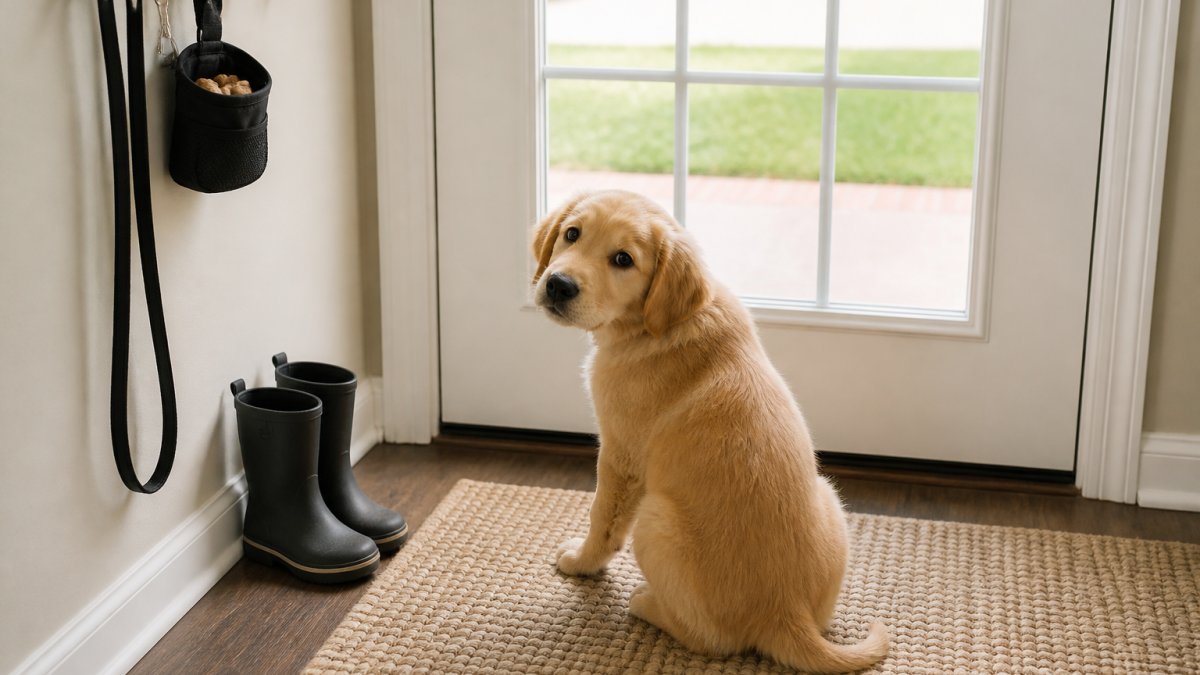
Quick Symptom-to-Solution Map
| What You See | Most Likely Cause | First Fix to Try |
|---|---|---|
| Soils indoors right after coming back inside | Trip was too short or too early | Wait longer outside; use the 10-10-10 timing |
| Soils the same indoor spot repeatedly | Residual scent cue | Clean with an enzymatic cleaner; block the spot |
| No warning before accidents | No taught signal | Pick one signal (bell, sit, scratch) and reward it every time |
| Soils in the crate | Crate too large or left too long | Right-size the crate; shorten confinement |
| Refuses to go outside, then goes inside | Distraction, weather, or discomfort | Quiet spot, stand still, reward immediately |
| Sudden accidents in a previously clean puppy | Possible medical issue | Call your vet; bring a urine sample |
When Your Puppy Refuses to Potty Outside
Refusal is usually about distraction, discomfort, or timing rather than stubbornness. Try a quiet spot away from traffic, other dogs, and people, and give the puppy a genuine chance to settle, many puppies need several minutes of standing still before they relax enough to go. Cold, wet, or windy weather makes many puppies hold it, so shorten the trip, protect the puppy from the worst of the weather, and reward any elimination immediately.
Teaching Your Puppy to Signal the Need to Go
Pick one signal and reward it every time, because a puppy that has no way to ask will simply go where it stands. Hanging a bell on the door and ringing it before every trip outside is the most common approach; a sit by the door or a scratch also works if you are consistent. The key is that the signal always produces a trip outside, even if the trip is short.
Stopping Accidents in the Crate and Confinement Area
A crate that is too large lets a puppy soil one corner and sleep in another, so size the crate so the puppy can stand, turn around, and lie down comfortably, no more. Take the puppy out right before crating and right after release, every single time. Watch out: leaving a puppy crated longer than its bladder can handle guarantees accidents and can slow house training, because the puppy learns to tolerate soiling its sleeping area.
Puppy Pads and Apartment Living: Refusals, Tearing, and Bad Weather
Pads work best as a stepping stone, not a permanent plan. Puppies tear them up because the texture is fun, so tape the edges or use a holder. If your puppy refuses pads, check the location: pads near food or bedding often fail. For apartment owners, use a consistent indoor spot near the door, then shift it outside as the puppy matures.
When to Call Your Vet About Potty Training Problems
Call your vet if accidents are sudden, frequent, or paired with straining, blood, or lethargy. A urinary tract infection or parasite can undo weeks of training. Bring a urine sample if you can, and note the accident times. For owners who want a full training and health foundation, the Happy Dog Bundle pairs potty training with broader puppy care.

Get the 14-Day Plan That Ends the Guesswork
Cleaning up accidents gets old fast. Our 14 Day Puppy Potty Training Bootcamp gives you a daily schedule, a supplies list, and clear steps for accidents, all in one instant PDF download for $24.99. Get started with RAK GROUP and give your puppy a routine that finally sticks.

Frequently Asked Questions
What is the 10-10-10 rule for puppy potty training?
The 10-10-10 rule is a simple timing guideline: take your puppy out first thing in the morning, again about 10 minutes after eating, and once more before bed. Some owners also use it to mean 10 minutes of supervision, 10 minutes of potty break, and 10 minutes of play. The core idea is that puppies need frequent, predictable potty breaks tied to meals and sleep, not just whenever you happen to think of it. Pair it with a written puppy potty training schedule so the timing stays consistent.
Why does my puppy keep having accidents in the house even after going outside?
A puppy that potties outside and then eliminates indoors within minutes was likely distracted outside or didn't fully empty its bladder. Try taking your puppy to the same potty spot each time, waiting up to five minutes, and rewarding immediately after elimination. If the accidents continue despite a consistent puppy potty training schedule, or your puppy is urinating very frequently, ask your vet to rule out a urinary tract infection or other medical cause before assuming it's a training problem.
How long does it realistically take to potty train a puppy?
Most puppies need several weeks to a few months of consistent house training before accidents become rare. A puppy's bladder control develops with age, so younger puppies simply cannot hold it as long. Expect progress in stages: fewer accidents by week two or three with a strict schedule, and near-reliable house training by around four to six months for many puppies. Regression during teething or schedule changes is normal, so track progress rather than expecting a straight line.
When should I contact a veterinarian about my puppy's potty training problems?
Call your vet if your puppy suddenly starts having accidents after a period of reliable house training, urinates much more frequently than usual, strains to urinate, has blood in the urine, or seems to drink far more water. These can signal a urinary tract infection or other medical issue that no amount of puppy potty training will fix. A quick vet check is the right first step before you change your training plan.
The hardest part of house training is not the puppy. It is keeping every person in the house on the same schedule. RAK GROUP built its guides to remove that guesswork, with day-by-day plans, potty logs, and simple routines you can print and post on the fridge. Order now and start the 14-day plan that turns accidents into progress.
