
Table of Contents
- What a Puppy Potty Training Schedule Template Actually Needs
- Puppy Potty Training Schedule by Age: 8 Weeks to 6 Months
- How to Build Your Daily Schedule: Step by Step
- Puppy Crate Training Schedule: Pairing the Crate With Potty Breaks
- Printable Puppy Potty Training Tracker: Why Paper Still Works
- Digital Tracking Tools for Busy Households
- Working Owner Schedules, Regressions, and Breed Differences
- Conclusion
- Frequently Asked Questions
Last Updated: September 23, 2026
What a Puppy Potty Training Schedule Template Actually Needs
A puppy potty training schedule template maps out exactly when your puppy eats, sleeps, plays, and goes outside to eliminate. This guide from RAK GROUP covers what to include, how to build it, and how to adjust it as your puppy grows.

The 10-10-10 Rule and Why It Works
The 10-10-10 rule is a simple structure: 10 minutes in the yard, 10 minutes of supervision, and a 10-foot designated potty area. Level Up Dog Training's potty training planner outlines this method for young puppies.
What to Put in Your Template Before Day One
- Your puppy's age in weeks
- Feeding times (three to four meals daily for young puppies)
- Crate and nap blocks
- Potty break intervals
- A potty command word
- High-value treats and a clicker if you use one
- A tracking log for accidents and wins
Puppy Potty Training Schedule by Age: 8 Weeks to 6 Months
The right puppy potty training schedule by age changes fast: young puppies have little bladder control, so breaks come often, while older puppies can hold it longer.
| Age | Waking Potty Breaks | Nighttime Breaks | Notes |
|---|---|---|---|
| 8-10 weeks | Every 60 min | 2-3 times | Bladder control is minimal |
| 12-16 weeks | Every 90 min | 1-2 times | Routine starts to stick |
| 4-5 months | Every 2-3 hours | 0-1 times | Accidents drop sharply |
| 6 months | Every 3-4 hours | Rarely | Near full control |
How Bladder Capacity Changes With Growth
Bladder capacity grows with the puppy, so a 10-week-old cannot hold it like a 5-month-old, which is why a static chart fails. Track growth alongside the schedule, and when accidents cluster at a certain time, add a break. The template should bend to your puppy, not the other way around.
How to Build Your Daily Schedule: Step by Step
Building a daily schedule takes about 20 minutes. Follow these steps, then adjust daily for two weeks.
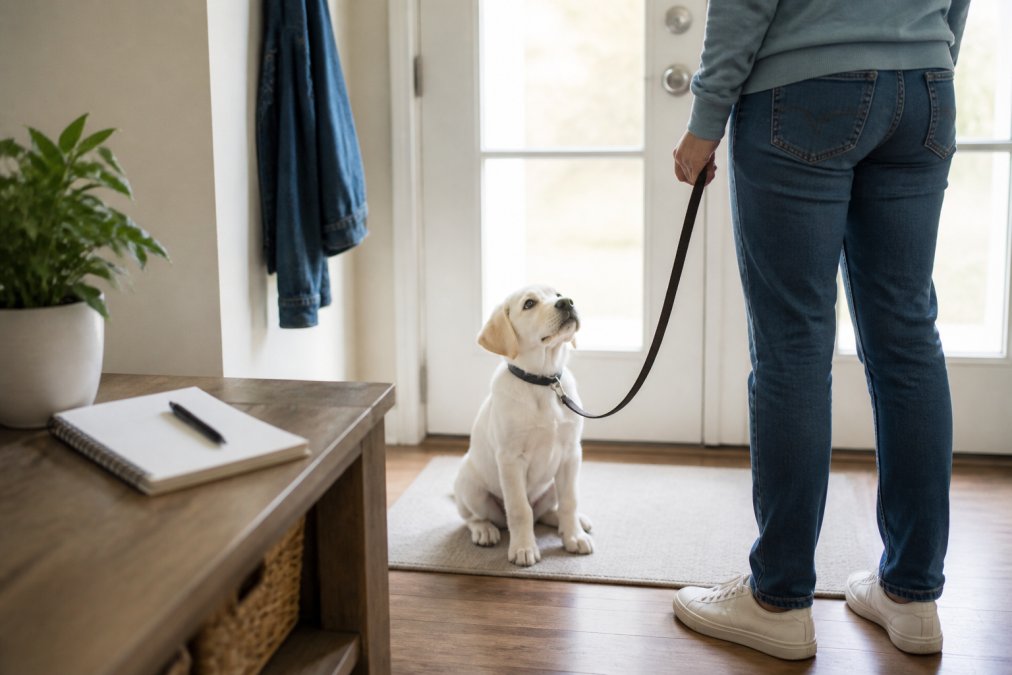
- Set a fixed wake-up time and stick to it.
- Schedule meals at the same times each day.
- Add potty breaks right after every meal, nap, and play session.
- Block out crate and nap periods.
- Log every break, meal, and accident for the first week.
- Review the log each night and shift times as needed.
Feeding, Hydration, and Potty Timing
A puppy usually needs to eliminate within 5 to 30 minutes of eating, so timing matters. Feed at set times, not free-feed, free-feeding makes potty timing unpredictable. Pull water about two hours before bedtime to cut nighttime breaks. PuppyBee's daily puppy schedule shows a routine with a 7:00 A.M. potty window, an 8:00 A.M. break, and an 8:20 A.M. meal.
Reading Potty Cues and Rewarding Success
Watch for sniffing the floor, circling, whining, or sudden restlessness. When you see a potty cue, go outside right away, then reward the moment your puppy finishes with a high-value treat and calm praise. The behavior you reward is the behavior you get.
Puppy Crate Training Schedule: Pairing the Crate With Potty Breaks
A puppy crate training schedule works best when the crate and potty breaks are linked: the crate teaches your puppy to hold it, and the breaks give them a place to go. But the crate only works when your template's timing matches your puppy's actual bladder capacity.
The Crate-to-Potty Handoff
Every crate exit should lead straight outside, on leash, to the same potty spot, no detours through the kitchen, no greeting the kids first. The sequence is: open crate, clip leash, walk to the door, go out. Let your puppy wander even two minutes after a nap and you have handed them a window to eliminate indoors.
Crate Duration by Age
The crate should never be used to stretch a puppy past their physical limit. Use the same age-based ceiling you use for potty breaks:
| Age | Max Crate Stretch (awake) | Max Crate Stretch (overnight) |
|---|---|---|
| 8-10 weeks | 30-45 min | 2-3 hours |
| 12-16 weeks | 60-90 min | 3-4 hours |
| 4-5 months | 2-3 hours | 4-5 hours |
| 6 months | 3-4 hours | 5-6 hours |
Crate Size and Placement
Crate size matters: your puppy should stand, turn, and lie down, but not much more, since extra room invites a corner accident. If you bought an adult-sized crate, use a divider panel and move it back as your puppy grows. Placement matters too, a back bedroom isolates the puppy and makes early potty cues harder to hear, while the main living area or your bedroom at night keeps you close enough to respond to the first whine.
What Not to Do
- Do not use the crate as punishment. It should be a neutral or positive space.
- Do not leave a puppy crated all day while you work. A midday break is non-negotiable at any age under 6 months.
- Do not feed meals inside the crate right before a long stretch. Feed, then potty, then crate.
- Do not ignore a whine because "they just want attention." In the first two weeks, assume every whine is a potty request.
Fading the Crate Over Time
As bladder control improves, leave the crate door open during short supervised periods. If your puppy chooses to nap there on their own, it has become a safe den rather than a cage. Keep the crate even after house training is solid, it remains useful for travel, vet visits, and times you need your puppy contained and calm.
Printable Puppy Potty Training Tracker: Why Paper Still Works
A printable puppy potty training tracker still beats most apps because it lives where the action happens: tape it to the fridge and grab a pen on your way out the door. Paper needs no login and no battery, and everyone in a busy household can see the last potty time at a glance.
14 Day Puppy Potty Training Bootcamp →
Digital Tracking Tools for Busy Households
Digital tracking tools help when more than one person handles the puppy, letting you log potty breaks, meals, sleep, and training in one tap. the Doggy Time app on the Apple App Store shows this shift toward app-based logging. If you work outside the home, an app keeps every caregiver on the same page.
Working Owner Schedules, Regressions, and Breed Differences
Most puppy potty training templates assume someone is home all day. This section covers three situations the top-ranking guides skip: a full workday away, a puppy that suddenly regresses, and breed-specific bladder differences that change your intervals.
The 9-to-5 Adaptation
A puppy under 6 months cannot hold it for an 8-hour workday, no template changes that biology. Build your schedule around a midday break.
A workable weekday structure looks like this:
| Time | Action |
|---|---|
| 6:30 A.M. | Wake, potty outside, feed |
| 7:00 A.M. | Potty again after eating |
| 7:30 A.M. | Play, train, potty before crate |
| 8:00 A.M. | Crate, leave for work |
| 12:00 P.M. | Midday break, walker, neighbor, or you |
| 12:30 P.M. | Potty, short play, water |
| 1:00 P.M. | Crate, return to work |
| 5:30 P.M. | Home, potty immediately |
| 6:00 P.M. | Feed |
| 6:30 P.M. | Potty after meal |
| 8:00 P.M. | Potty, wind-down |
| 10:00 P.M. | Final potty, bedtime |
Regression Troubleshooting
A puppy that was doing well and suddenly stops using the designated spot is not being spiteful. Regression has causes, and each has a fix.
Common triggers:
- Teething (around 4-6 months): Discomfort can disrupt routine. Add a break, not a punishment.
- Growth spurt: A puppy that could hold it for 3 hours last week may only manage 2 this week. Shrink the intervals temporarily.
- Schedule change: A new work shift, a houseguest, or a move resets the routine. Rebuild from the 8-week baseline for 3-5 days.
- UTI or digestive upset: If accidents are frequent, small, or paired with straining, call your vet. This is a medical issue, not a training one.
- Too much freedom: If you gave the puppy free roam of the house too early, pull back to supervised or crated time and earn freedom back in small increments.
Breed-Specific Bladder Capacity
Breed size changes the math. A Chihuahua at 10 weeks has a much smaller bladder than a Labrador at 10 weeks, even though they are the same age. Generic schedules ignore this, which is why so many small-breed owners feel like they are failing when they are not.
| Size Category | Examples | Typical Bladder Maturity | Interval Adjustment |
|---|---|---|---|
| Toy (under 10 lbs adult) | Chihuahua, Yorkie, Maltese | 6-8 months | Cut standard intervals by ~25% |
| Small (10-25 lbs) | Beagle, Shih Tzu, Pug | 5-7 months | Cut standard intervals by ~15% |
| Medium (25-60 lbs) | Border Collie, Bulldog | 4-6 months | Standard intervals |
| Large (60-100 lbs) | Labrador, German Shepherd | 4-5 months | Standard intervals |
| Giant (100+ lbs) | Great Dane, Mastiff | 4-5 months | Standard intervals, but watch for joint issues on stairs |
Building a Schedule That Survives Real Life
The template that works fits your actual week, not an idealized one. If you work outside the home, build the midday break in first, then fill the rest. If you have a small breed, shorten every interval by 15-25%. If your puppy regresses, tighten rather than restart.
Conclusion
House training a puppy is a scheduling problem, not a willpower problem. Set clear times, track results, and adjust as your puppy grows, and accidents drop fast. RAK GROUP makes that easier: our 14 Day Puppy Potty Training Bootcamp gives you a day-by-day plan, potty schedules that fit your routine, and honest guidance on handling accidents, as an instant PDF download you can keep on your phone or print for the fridge.
Frequently Asked Questions
What is the 10-10-10 rule for potty training puppies?
The 10-10-10 rule means 10 minutes in the yard, 10 minutes of supervision, and a 10-foot designated potty area, according to Level Up Dog Training (2026). It keeps each potty trip short and focused so your puppy learns that outside means business, not play. If nothing happens in those 10 minutes, bring the puppy back inside, supervise closely, and try again 15 to 20 minutes later rather than waiting in the yard indefinitely.
How often should I take my puppy out with a potty training schedule template?
Puppies aged 8 to 10 weeks need a potty break every 60 minutes during waking hours, per Level Up Dog Training (2026). Chewy's 2026 guidance puts the range at once every 30 to 60 minutes on-leash, followed by praise and a treat. A puppy potty training schedule template should build those intervals into your day, then stretch them gradually as your puppy's bladder control improves over the following weeks.
How do I use a printable puppy potty training tracker effectively?
Print the tracker and keep it where you take your puppy out, such as by the back door or on the fridge. Log every potty break, meal, and accident with the time it happened. After a week, patterns emerge: you will see which hours your puppy reliably needs to go and which trips are wasted. Chewy publishes downloadable checklists in 2026, and a 14-day structured plan can give the log a clear framework.
How long can a 9-week-old puppy hold their bladder at night?
Most 9-week-old puppies can hold their bladder for roughly two to three hours overnight, not the full night. Plan one or two nighttime potty breaks, taken on-leash to the same outdoor spot with minimal light and no play. Set an alarm rather than waiting for whining, because a puppy who wakes and paces in the crate has often already reached their limit.