
Table of Contents
- Why Owners Look for a Pupford Alternative for Puppy Training
- How to House Train a Puppy Fast With a Structured Plan
- Low Calorie Dog Training Treats: What to Look For
- Best Puppy Training Treats for Sensitive Stomachs
- Pupford Alternative for Puppy Training: Comparing Digital Guides and Treat Approaches
- Common Mistakes When Choosing a Puppy Training Program
- Conclusion: Matching Your Puppy's Needs to the Right Training Plan
- Frequently Asked Questions
Last Updated: September 27, 2026
Why Owners Look for a Pupford Alternative for Puppy Training
The dog training services market is projected to reach USD 9.6 billion by 2034, according to Lisa Regan's industry outlook on LinkedIn, and much of that growth is moving toward app-based, owner-led education. That shift explains why so many new owners search for a Pupford alternative for puppy training: they want a structured plan, not a pile of disconnected videos.
How to House Train a Puppy Fast With a Structured Plan
The fastest way to house train a puppy is a fixed daily schedule with timed potty breaks, close supervision, and immediate rewards. Most puppies need a break every one to two hours during the day, plus once or twice overnight, until bladder control develops.
-
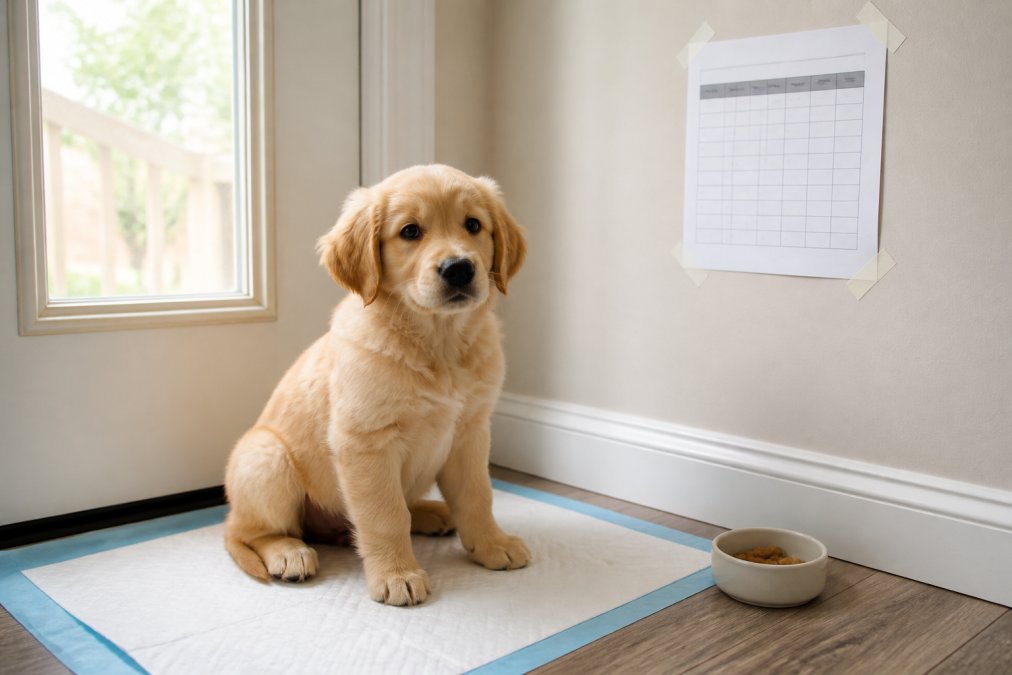
A young golden retriever puppy sitting beside a back door on a puppy pad, a printed daily schedule taped to the wall and a small ceramic bowl of training treats on the floor, soft morning light through a window
- Set fixed meal times and remove water two hours before bed
- Take the puppy out first thing in the morning, after every meal, after naps, and after play
- Go to the same spot each time and wait up to five minutes
- Reward immediately with a tiny treat and calm praise
- Clean accidents with an enzymatic cleaner so the scent doesn't draw the puppy back
Low Calorie Dog Training Treats: What to Look For
A training treat should be small, low in calories, and easy to break apart. Repetition is the whole point of reward-based training, so a puppy may eat 20 to 30 treats in a single session. At that volume, caloric density matters as much as flavor.
Look for these markers on the label:
- Under 2 calories per treat so frequent rewards don't crowd out balanced meals
- A short ingredient list with a named protein first
- Bite-sized pieces that swallow quickly without breaking focus
- Soft texture for fast delivery during luring and quick repetitions
Best Puppy Training Treats for Sensitive Stomachs
The best training treats for sensitive stomachs are single-ingredient or limited-ingredient options with no artificial preservatives, colors, or fillers, and, critically, a protein your puppy has not already been eating in its main diet. That last point is where most owners go wrong. If your puppy's kibble is chicken-based and you reward with chicken treats, you cannot tell whether a loose stool came from the food or the reward.
Why novel proteins help
A novel protein is one the puppy's immune system has not been exposed to. Common choices are salmon, turkey, lamb, venison, and whitefish. The mechanism is straightforward: food sensitivities tend to develop against proteins a dog eats frequently, so rotating to something new gives you a clean baseline. Introduce one new protein at a time over three to five days before adding another.
Texture and digestion
Soft and chewy treats digest faster and deliver faster than hard biscuits, which matters when you are rewarding 20 to 30 times in a session. Hard biscuits also press into a teething puppy's gums. Freeze-dried treats sit in the middle: light, highly palatable, and easy to crumble into pea-sized pieces. Dehydrated jerky is convenient for long sessions but is the most common place added sugar and glycerin hide, so read the panel.
Comparative nutrition at a glance
Most guides tell you which brands to buy. Fewer tell you what the numbers actually mean. The table below compares treat categories by the metrics that matter for a puppy eating dozens of rewards a day.
| Treat Type | Typical Calories per Piece | Protein Profile | Fat Level | Best For | Watch Out For |
|---|---|---|---|---|---|
| Single-ingredient soft (e.g., freeze-dried liver) | Under 2 | Single named protein | Moderate | Sensitive stomachs, high-value rewards | Short shelf life once opened; can be rich |
| Freeze-dried raw protein | Low, varies by size | Single protein | Varies | Luring, distraction training | Crumbles; weigh portions to avoid overfeeding |
| Dehydrated jerky | Moderate | Usually single protein | Often higher | Long training sessions | Check for added sugar, glycerin, and salt |
| Crunchy biscuit | Higher per piece | Often multi-ingredient | Lower | Teething puppies | Harder to break small; slower to eat |
| Boiled chicken or lean meat (DIY) | Very low | Single protein you control | Low | Puppies with known allergies | Refrigerate within two hours; use within three days |
Training-specific use cases
- Luring (guiding a puppy into a sit or down): use a soft, smelly treat you can hold at nose level and move smoothly. Freeze-dried liver works well because it does not crumble in your fingers.
- Rewarding (marking a correct behavior): use a pea-sized soft treat delivered within one second of the marker word or click.
- Distraction training (working near other dogs, traffic, or dropped food): reserve your highest-value reward, often real meat or a novel-protein freeze-dried piece, for these moments only. If you use it for everything, it stops being high-value.
A treat that lists one protein and nothing else is the safest starting point. Introduce any new treat one at a time over several days so you can spot a reaction before it becomes a pattern.
14 Day Puppy Potty Training Bootcamp →
Pupford Alternative for Puppy Training: Comparing Digital Guides and Treat Approaches
Most owners comparing a Pupford alternative for puppy training are really choosing between two things: a digital curriculum that teaches the owner, and a treat strategy that rewards the puppy. The strongest plans do both.
| Approach | What It Delivers | Best For | Limitation |
|---|---|---|---|
| App-based curriculum | Video lessons, progress tracking | Owners who want to learn theory | Little household scheduling support |
| Digital day-by-day guide | Fixed 14-day potty plan | Busy families | Narrower scope than full obedience |
| Treat-led training | Fast rewards, high motivation | Puppies with short attention spans | Treats alone don't teach structure |
| Combined plan | Curriculum plus daily schedule | Most new owners | Requires daily consistency |
Common Mistakes When Choosing a Puppy Training Program
The biggest mistake is choosing a program by price alone. A free video series costs nothing and often gets abandoned by week two, because nothing in it accounts for your actual daily rhythm. The second biggest mistake is choosing a program that ignores your puppy's age, and that is the gap most guides never address.
Age-appropriate texture and schedule guide
An 8-week-old and a 6-month-old need different schedules, different treat textures, and different session lengths. Treating them the same is one of the most common reasons training stalls.
| Puppy Age | Bladder Control | Treat Texture | Session Length | Key Focus |
|---|---|---|---|---|
| 8-10 weeks | 1 hour or less | Very soft, pea-sized | 2-3 minutes | Potty routine, name recognition |
| 10-14 weeks | 1-2 hours | Soft and chewy | 3-5 minutes | Sit, come, crate comfort |
| 3-4 months | 2-3 hours | Soft or freeze-dried crumble | 5 minutes | Leash manners, impulse control |
| 4-6 months | 3-4 hours | Soft to semi-firm | 5-10 minutes | Distraction training, stay |
| 6-12 months | 4+ hours | Any, including crunchy | 10-15 minutes | Proofing behaviors in new places |
DIY training treats: full control over ingredients
If your puppy has known allergies or you simply want to control every input, homemade treats fill a gap commercial lists never touch. Three reliable options:
- Boiled chicken or turkey breast, diced to pea size. Plain, no seasoning. Refrigerate and use within three days.
- Freeze-dried liver cubes you portion yourself. High value, low calorie per piece, no additives.
- Baked sweet potato cubes, cut small and cooled. Soft, slightly sweet, and cheap to make in batches.
Other frequent errors
- Switching methods every week. Inconsistent signals confuse a puppy faster than any single flawed method. Pick one plan and run it for at least 14 days before judging results.
- Overfeeding treats. A session of 30 full-size treats can add meaningful calories to a small puppy's day. Keep treats under roughly 10% of daily calories.
- Skipping the household briefing. If one person rewards jumping and another ignores it, the puppy learns nothing. Write the rules down and post them where everyone sees them.
- Assuming every behavior problem is a training problem. As trainer Zak George has noted, some issues stem from underlying pain or health conditions that training alone cannot resolve. A sudden change in behavior warrants a vet visit.
- Buying a program with no household scheduling component. A curriculum tells you what to teach. It rarely tells you how to fold potty breaks into a school run, a work call, and dinner.
Conclusion: Matching Your Puppy's Needs to the Right Training Plan
House training stalls when the plan doesn't match the household. The puppy isn't the variable; the routine is. Pick one structured guide, pair it with small low-calorie treats, and repeat the same sequence every day for two weeks before judging results.
Frequently Asked Questions
Are Pupford training treats good for puppies?
Pupford training treats are formulated for puppies and come in small, low-calorie pieces. Each treat is under 2 calories, and a 5 oz bag contains over 250 treats, which makes frequent rewarding during training sessions practical. The single-ingredient options and freeze-dried textures suit many puppies, though individual tolerance varies. If your puppy has a sensitive stomach, introduce any new treat slowly and watch for digestive changes.
What should I look for in a puppy training treat?
Focus on small size, low caloric density, and a short ingredient list. Treats should be soft and chewy or freeze-dried so they break easily for quick rewards. Look for single-ingredient proteins and avoid artificial preservatives. For sensitive stomachs, choose limited-ingredient options and check that the treat is easy to digest. A treat that is too large or too high in calories can disrupt your puppy's daily allowance and training focus.
How many training treats should a puppy have per day?
Treats should make up no more than 10 percent of a puppy's daily calories. Because many training treats are under 2 calories each, you can use several small pieces per session without overfeeding. Break treats into pea-sized bits and subtract those calories from your puppy's regular meals. If you are using a structured guide, it often includes a daily allowance guide to help you stay on track without spoiling your puppy's appetite.
What is the best low-calorie alternative for puppy training?
Low-calorie training treats under 2 calories per piece are ideal for frequent rewarding. Freeze-dried single-ingredient treats and soft chews made with limited ingredients work well. Some owners also use small pieces of cooked chicken or carrot, but commercial treats offer consistent size and calorie counts. Pairing a low-calorie treat with a structured house training plan, such as a 14-day bootcamp, helps you reward often without overfeeding.