
Table of Contents
- What Digital Puppy Training Actually Delivers in 2026
- Online Puppy Training vs In-Person Classes: Which Wins?
- How Long Does It Take to Train a Puppy Online?
- How to House Train a Puppy Fast (Without Losing Your Mind)
- The Hybrid Model: Why the Smartest Owners Mix Both
- The Verdict: Is Digital Puppy Training Worth It for Your Family?
- Frequently Asked Questions
Last Updated: October 2, 2026
What Digital Puppy Training Actually Delivers in 2026
The global dog training services market is valued at USD 43.8 billion in 2026, according to Business Research Insights market report, and it is forecast to reach USD 99.96 billion by 2035. That growth tells you something simple: owners are spending more on training than ever, and a large share of that spending now goes to digital puppy training.
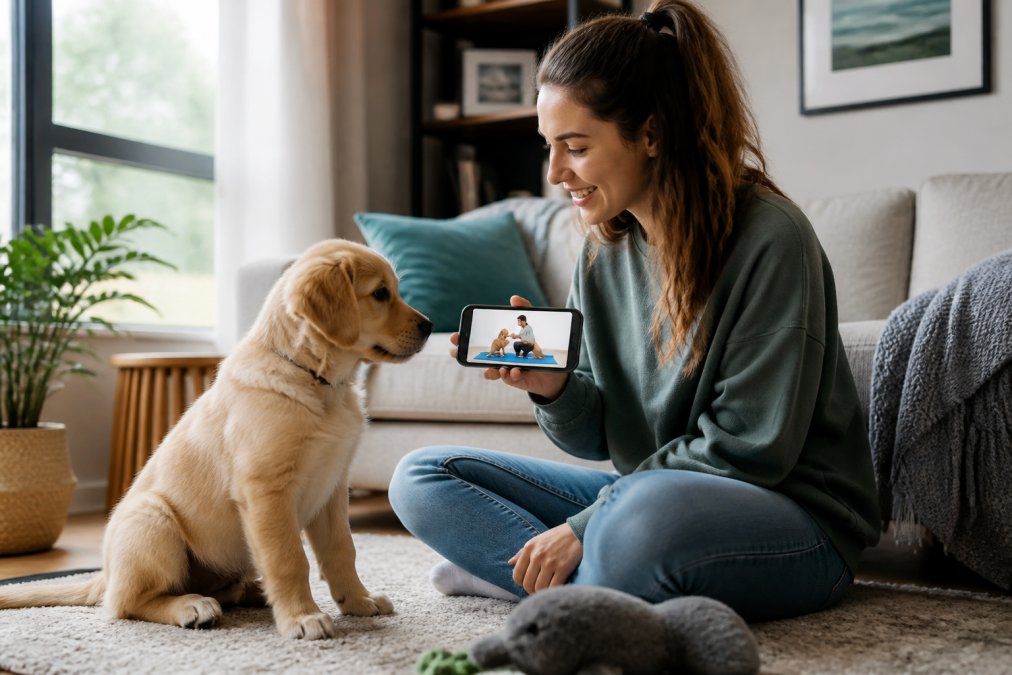
Why the Market Is Booming
Demand is at an all-time high as owners prioritize behavior and relationship-building, according to Method K9 industry analysis. AI-powered tools have also become a new standard in 2026 training methods, per PetWorks trend report. The appeal is practical: families who cannot fit traditional classes into their schedules now have a workable alternative.
What the Apps Do Well (and What They Miss)
Apps teach foundational skills well: sit, recall, toilet training, and socialization, provided the platform uses verified trainer credentials. The gap is judgment. The American Animal Hospital Association warns that some digital tools lead owners to delay veterinary care for behaviors rooted in medical issues.
Online Puppy Training vs In-Person Classes: Which Wins?
Neither wins outright, and that is the honest answer most comparison articles avoid. Wag and Train found virtual learning to be equally effective as in-person instruction, and in some cases more effective for the human family. The difference is in what each format trains.
| Factor | Online Training | In-Person Classes |
|---|---|---|
| Cost | Lower, one-time fee | Higher, per-session |
| Scheduling | On demand | Fixed weekly times |
| Distraction practice | Limited | Built in |
| Trainer feedback | Video review or chat | Real-time, hands-on |
| Best for | Busy households | Reactive or fearful puppies |
The Cost Math Most Articles Skip
A single group puppy class typically runs $150 to $250 for a six-week block, and private in-person sessions commonly land between $75 and $150 each. A digital course or app subscription usually sits between $20 and $200 for the full program, with most one-time puppy courses clustering under $50. That gap is real, but it is not the whole story.
How to Choose the Right Online Program
Not every app deserves your money. Run any candidate through this filter before you buy:
- Verified trainer credentials. Look for names you can search, certifications you can confirm, and a stated training philosophy. Anonymous video libraries are a red flag.
- A structured sequence, not a video dump. Good programs tell you what to do on day one, day two, and day fourteen. A searchable library of 400 clips is not a curriculum.
- Feedback loop. Live virtual coaching, video review, or a moderated community. If you can never get a human to look at your puppy's specific behavior, you are paying for entertainment.
- Refund window. A seven- to fourteen-day refund policy is standard for reputable programs. No refund policy means no recourse.
- Puppy-specific content. Adult dog training content does not transfer cleanly. You want bite inhibition, socialization windows, and house training built in.
The Technical Setup Nobody Mentions
This is the part the top-ranking comparison articles leave out entirely, and it is where most virtual training sessions quietly fail. Before you commit to a digital program, check four things:
- Internet upload speed. Video coaching is two-way. If your upload speed is sluggish, your trainer sees a frozen frame instead of your puppy's behavior. Run a speed test before your first session.
- Camera angle. A phone propped on a couch cushion films the ceiling. You need a stable mount at roughly your puppy's eye level, angled so the trainer can see both the puppy and your hands.
- Lighting. Backlit windows turn your puppy into a silhouette. Face the light source, or train in a room with even overhead lighting.
- Audio. A clip-on mic or a quiet room matters more than you think. Trainers cannot correct a behavior they cannot hear you cue.
Limitations of Virtual Learning
Digital training has real ceilings. It cannot replicate a room full of strange dogs, a stranger at the door, or a toddler grabbing a tail. It cannot assess a limp, a skin issue, or a sudden behavior change that turns out to be pain. And it cannot physically place a leash or interrupt a reactive lunge. For foundational obedience and house training, those limits rarely matter.
What the Experts Actually Say
The consistent message from trainers on both sides is that the format is not the variable. The variable is whether the owner runs short, frequent, structured sessions and adjusts based on feedback. Remote instruction works when it is treated like a class with homework, not like a streaming service. That is the honest answer to the comparison, and it is the one that should drive your decision more than any feature list.
How Long Does It Take to Train a Puppy Online?
Most puppies reach reliable basic obedience in 8 to 16 weeks of daily online training, with house training typically resolving first. A study from California State University, Monterey Bay found that owners who engaged in structured training research and application saw significant behavior improvements by course completion.
How to House Train a Puppy Fast (Without Losing Your Mind)
House training moves fastest when you control the schedule instead of reacting to accidents. Follow this sequence:
14 Day Puppy Potty Training Bootcamp →
- Feed at fixed times, then remove the bowl
- Take the puppy out every 60 to 90 minutes, plus after every nap
- Go to the same spot each time and wait five minutes
- Praise immediately after elimination, not when you get back inside
- Clean accidents with an enzymatic cleaner, never ammonia
- Log every accident for three days to spot the pattern
- Extend the interval by 15 minutes each successful week
The Hybrid Model: Why the Smartest Owners Mix Both
The strongest results come from combining formats, not choosing between them. Use digital training for daily repetition and house training, then book a handful of in-person sessions for distraction work and socialization.
A Concrete Hybrid Schedule
Most owners who mix formats land on a pattern like this:
- Weeks 1 to 4: Digital program only. Focus on name recognition, sit, come, and the start of house training. Ten minutes, twice a day.
- Weeks 5 to 8: Add two to four in-person sessions. Use them for puppy socialization, handling, and distraction work in a room with other dogs.
- Weeks 9 to 16: Return to digital for daily maintenance and advanced cues. Book a single in-person session only when a specific behavior stalls.
Which Puppies Benefit Most From Home-Based Training
Temperament matters more than breed, but both shape the decision.
- Shy or easily overwhelmed puppies often do better starting at home. A group class can flood a fearful puppy before it has learned to cope. Build confidence digitally first, then introduce controlled in-person exposure.
- High-drive, high-energy puppies benefit from the structure a digital program provides, but they need the distraction work that only an in-person setting delivers. Do not skip the hybrid step with these dogs.
- Reactive puppies are the clearest case for in-person help. Virtual coaching can guide you, but a certified trainer who can read the dog in real time is worth the money.
- Breed tendencies are a useful signal, not a rule. Working and herding breeds tend to need more mental engagement and more proofing around other dogs. Companion breeds often thrive on a digital foundation alone. Treat this as a starting hypothesis, not a verdict.
Success Metrics Beyond Obedience
Obedience cues are the easiest thing to measure and the least useful thing to track. A puppy that sits on cue but panics at the door is not trained. Track these instead:
- Owner confidence. Rate yourself from 1 to 5 each week on how equipped you feel to handle a new behavior problem. This is the single best predictor of whether you will keep going.
- Reduction in specific nuisance behaviors. Pick two, not ten. Count jumping on guests, or accidents, or demand barking, and log the number each week. A downward trend over four weeks is real progress.
- Recovery time. How many seconds does your puppy take to settle after a doorbell, a dropped pan, or a stranger? This number should fall over time.
- Check-ins on walks. How often does your puppy look back at you without being called? Rising check-ins signal a strengthening relationship, which is the actual goal.
- Generalization. Can your puppy perform the cue in three different rooms, on two different surfaces, with one mild distraction? If not, the cue is not learned yet.
When to Stop and Call a Professional
Hybrid training has a boundary. If your puppy shows fear, aggression, resource guarding, or a sudden behavior change, stop the digital program and get eyes on the dog. A veterinarian rules out pain and medical causes first. A certified in-person trainer or veterinary behaviorist handles the rest. No app, no matter how well designed, replaces that step.
The Verdict: Is Digital Puppy Training Worth It for Your Family?
For most busy households, yes. Digital puppy training is worth it when you want structure, daily guidance, and a lower cost than weekly classes, and it works especially well for house training and foundational obedience. It is not worth it if your puppy shows fear, aggression, or a behavior that might be medical; those cases need a veterinarian or a certified in-person trainer first.
Frequently Asked Questions
Does virtual dog training really work?
Yes, for foundational skills. A 2026 American Animal Hospital Association report notes that digital training apps can improve behavioral outcomes, and a 2019 California State University study found structured online training significantly improved puppy behavior. Virtual coaching works best for sit, recall, potty training, and socialization. However, some trainers argue physical presence is still needed for hands-on correction of certain behaviors, so pick a program with verified trainer credentials.
How does online puppy training compare to in-person classes?
In-person classes offer a high-distraction environment that is hard to replicate at home, which helps puppies generalize skills. Online programs offer flexibility, lower cost, and the ability to rewatch lessons. Case studies like Wag and Train found virtual learning equally effective as in-person for many families. The best approach often combines both: online for daily routines and in-person for socialization practice.
Is digital puppy training cost-effective compared to private trainers?
Digital programs are typically far cheaper than private trainers, who can charge $50-$150 per session. A structured guide like RAK GROUP's 14 Day Puppy Potty Training Bootcamp costs $29.99 and provides a day-by-day plan, potty schedules, and troubleshooting tips. Over a 14-day period, that is a fraction of the cost of even one private session, making it a cost-effective starting point for house-training.
What should I look for in a high-quality digital puppy training course?
Look for verified trainer credentials, a clear curriculum that covers potty training, socialization, and basic obedience, and interactive elements like real-time feedback or progress tracking. Also review the refund policy and whether you can access materials on your phone for quick reference during training sessions.
The hardest part of puppy training is not knowing what to do. It is knowing what to do today, when you are already tired and the schedule has fallen apart. RAK GROUP builds digital guides for exactly that moment, with day-by-day plans, printable schedules, and instant PDF delivery so there is nothing to wait for. Shop now and give your puppy the structure it needs, one day at a time.