
Table of Contents
- Set Up for Success Before Day One
- Build a Puppy Potty Training Schedule That Works
- Crate Training for Puppies: The Fastest Path to Bladder Control
- How to Handle Puppy Accidents Without Slowing Progress
- Puppy House Training Timeline: What to Expect Week by Week
- Troubleshooting Regression and Medical Red Flags
- Frequently Asked Questions
Last Updated: September 21, 2026
Set Up for Success Before Day One
Most attempts to house train a puppy fail before the first accident: the setup is wrong, not the puppy.
Here's what to gather before your puppy comes home:
- A crate sized so your puppy can stand, turn, and lie down
- An enzyme cleaner made for pet messes
- Treats cut into pea-sized pieces for quick rewards
- A leash for trips to the potty spot
- A timer or phone reminder for the schedule
Gather Your Supplies and Pick a Potty Spot
Choose a spot close to the door and easy to reach at night. Distance matters at 2 a.m.
Establish a Feeding and Water Schedule
Feed your puppy at the same times each day, three meals until about four months old, then two. Pick up the water bowl about two hours before bedtime; this one habit cuts nighttime accidents more than anything else. A fixed feeding schedule makes the potty schedule predictable: you cannot time output without timing input.
Build a Puppy Potty Training Schedule That Works
A puppy potty training schedule is a written plan for when your puppy eats, drinks, sleeps, and goes out. The core rule: out after waking, after eating, after playing, and before bed, plus every one to two hours while awake.
| Time | Activity | Potty Trip |
|---|---|---|
| 6:30 a.m. | Wake up | Immediately outside |
| 7:00 a.m. | Breakfast | 10-15 minutes after eating |
| 9:00 a.m. | Nap | Right after waking |
| 12:00 p.m. | Lunch | 10-15 minutes after eating |
| 3:00 p.m. | Play | After play ends |
| 6:00 p.m. | Dinner | 10-15 minutes after eating |
| 9:00 p.m. | Wind down | Before crate |
| 11:00 p.m. | Last call | Right before bed |
The 7-7-7 Rule and What It Means for Timing
The 7-7-7 rule is a common guideline: seven days to settle in, seven weeks to build trust, seven months to feel fully at home. Treat it as a rough map, not a deadline.
Crate Training for Puppies: The Fastest Path to Bladder Control
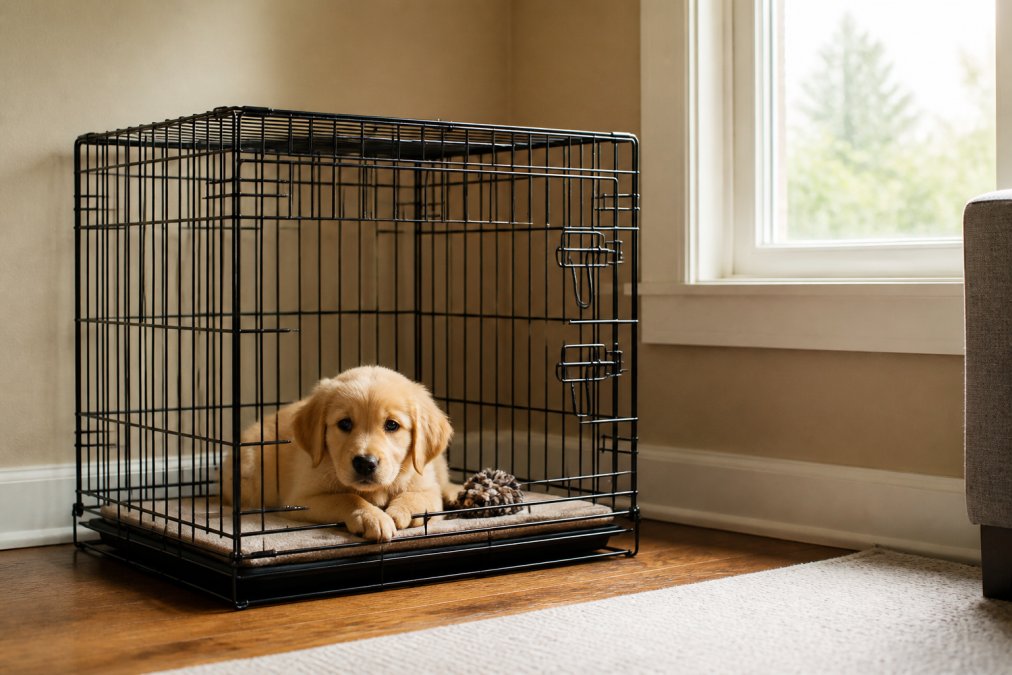
Crate training for puppies works because dogs avoid soiling their sleeping space. A crate turns that instinct into your best house-training tool, but only if it is sized, introduced, and scheduled correctly. Get any of those three wrong and the crate causes accidents instead of fixing them.
Size the Crate Correctly
Get the size right. Too big and your puppy will potty in one corner and sleep in the other; too small and they cannot stand, turn, and lie down comfortably. Measure from the tip of the nose to the base of the tail, then add two to four inches, that is the minimum interior length.
Introduce the Crate in Stages
Make the crate a good place before you ever close the door: feed meals inside, toss treats in, and never use it as punishment. A common pattern:
- Days 1-2: Crate door stays open. Toss a treat in, let the puppy walk in and out freely. Feed one meal inside with the door open.
- Days 3-4: Close the door for 30 seconds while your puppy eats, then open it. Build to one minute, then five.
- Days 5-7: Crate your puppy for short stretches while you are home and visible, 10 to 15 minutes at a time. Return before they whine.
- Week 2: Start leaving the room for 5 to 10 minutes at a time. Return quietly, without a big greeting.
- Week 3: Begin overnight crating and short absences of 30 to 60 minutes.
How Long Can a Puppy Hold It?
The Working Owner's Crate Plan
Most crate-training advice assumes someone is home all day. If you work outside the home, the crate alone will not carry a young puppy through a full workday, and forcing it to try creates a puppy comfortable soiling their bed. A realistic plan:
- Under 4 months old: A midday visit is not optional. Hire a dog walker, ask a neighbor, or come home at lunch. Two crating stretches of roughly four hours each, with a potty break and a short play session in between, is the ceiling.
- 4 to 6 months old: Many puppies can stretch to a five- to six-hour morning block if they got a real potty break and exercise before you left. A midday walker is still the safer choice.
- 6 months and up: Most puppies can handle a full workday in the crate if they get a vigorous morning potty-and-play session and an immediate trip outside when you get home.
When to Stop Using the Crate
Crating is a training tool, not a life sentence. Once your puppy has gone four to six weeks without an accident and reliably signals at the door, give short periods of freedom in one puppy-proofed room, expanding gradually. If accidents return, shrink the space and add a week before trying again.
How to Handle Puppy Accidents Without Slowing Progress
Accidents will happen. How you react decides whether they slow you down.
Puppy House Training Timeline: What to Expect Week by Week
The puppy house training timeline varies by breed, size, and age, but most puppies follow a similar arc; small breeds often take longer because they have smaller bladders. Below is what most trainers see with a puppy who started between 8 and 12 weeks old on a consistent schedule.
Weeks 1-2: Building the Routine
Expect frequent accidents, your puppy has almost no bladder control yet and does not understand what you want. Your only job is to hit the schedule: out after waking, after every meal, after every play session, and every one to two hours while awake. Reward every outdoor success within two seconds; do not expect door signals yet.
Weeks 3-4: First Signs of Control
Accidents drop noticeably if the schedule has held, and your puppy starts to associate the potty spot with the act. Watch for pauses, sniffing, or circling before squatting, the early cues you want to catch. Add a verbal cue like "go potty" as they begin to eliminate, not before.
Weeks 5-6: The Door Signal Emerges
Many puppies begin showing some form of signal, sitting by the door, staring, or pacing, but it is often subtle. Miss it and you get an accident, and the signal gets weaker, so watch closely. Some puppies never develop a clear signal; a bell on the door handle, rung before every trip outside, gives them one.
Weeks 7-8: Reliability Under Supervision
Most puppies are largely reliable while supervised by this point, the key phrase is while supervised. Free roam is still months away, so keep your puppy in the same room, on a leash or tethered to furniture if needed, to catch the pre-potty cues.
Months 3-4: Bladder Control Matures
Bladder control continues to develop: a 4-month-old puppy can typically hold it four to five hours during the day. Most are accident-free during the day if the schedule holds, with occasional overnight slips. This is when many owners relax supervision, and exactly when accidents come back.
Months 5-6: The Regression Window
Here is what most guides skip: many puppies who were reliably house-trained at 4 months start having accidents again at 5 to 6 months. This is not a training failure but a predictable developmental stage with known triggers.
Common triggers for a 4- to 6-month regression:
- Too much freedom too soon. The puppy earned more house access, and the owner stopped watching. Shrink the space back down.
- A schedule change. A new job, a move, a new baby, a houseguest, or a shift in feeding times. Puppies are routine-dependent; the routine broke before the training did.
- Teething. Discomfort around 4 to 6 months can increase water intake and disrupt sleep, which disrupts the potty schedule.
- Adolescence. Around 6 months, puppies enter a developmental phase roughly analogous to the teenage years. Previously learned behaviors get tested. House training is one of them.
- A urinary tract infection or parasites. If the regression comes with straining, dribbling, blood in the urine, increased thirst, or diarrhea, it is a vet question, not a training question.
How to fix a regression:
- Go back to the week-1 schedule, out every one to two hours while awake.
- Reintroduce the crate or tether your puppy to you during the day.
- Reward every outdoor success like it is the first one.
- Clean every accident spot with an enzyme cleaner so the scent does not pull your puppy back.
- Hold the tighter routine for at least two weeks past the last accident before loosening it again.
What "Fully House Trained" Actually Means
Most puppies are not truly reliable until 6 to 8 months, and some small breeds take longer. "Reliable" means no accidents for four to six consecutive weeks with normal house access and no constant supervision. Until you hit that mark, treat every unsupervised minute as a training rep.
Troubleshooting Regression and Medical Red Flags
A sudden return of accidents after weeks of progress is potty regression, and it usually has a fixable cause: a schedule change, a move, a new person in the home, or too much freedom too soon. Go back to basics, more frequent trips, closer supervision, and the crate. Some causes need a vet, not a trainer.
- Accidents after months of being clean, with no routine change
- Straining, crying, or frequent dribbling
- Blood in urine or a sudden increase in thirst
- Diarrhea or vomiting alongside accidents
Frequently Asked Questions
What is the 7-7-7 rule for puppies?
The 7-7-7 rule describes a puppy's adjustment period after adoption: roughly 7 days to decompress, 7 weeks to settle into routines, and 7 months to feel fully at home. For house training, it means you should expect accidents during the first week while your puppy learns your schedule. Stick to a consistent potty routine, and most puppies show steady improvement by the end of the first month.
How long does it take to fully house train a puppy?
Most puppies need 4 to 6 months of consistent house training before they are reliably house-trained. Small breeds and puppies under 12 weeks have limited bladder control, so progress is gradual. A structured puppy potty training schedule with frequent outdoor trips, crate training, and immediate rewards speeds up the process. Some puppies reach reliability by 16 weeks; others need until 6 months.
Is it possible to potty train a puppy in 3 days?
You can establish the beginnings of a routine in 3 days, but full house training takes weeks. During a 3-day intensive, take your puppy out every 30 to 60 minutes, reward immediately after elimination, and supervise constantly indoors. This jumpstarts the habit, but puppies under 16 weeks still have accidents as their bladder control develops. Consistency over months matters more than any shortcut.
How often should a puppy go out to potty?
A general guideline is to take your puppy out every hour for each month of age, plus immediately after waking, eating, drinking, playing, and before bedtime. A 3-month-old puppy needs a potty break roughly every 3 hours during the day. At night, most puppies can hold it 4 to 6 hours by 12 weeks. Adjust based on your puppy's size, breed, and individual bladder control.
House training a puppy fast comes down to consistency, not luck. RAK GROUP builds digital tools that bring order to busy family schedules, including structured guides for puppy potty training and household time management. Our resources focus on digital clarity and elegant, easy-to-follow layouts, so you spend less time planning and more time with your puppy. Shop now and give your family a calmer, better-organized start.