
Quick Summary
To calm a high-energy puppy at home, dim the lights, offer a sniffing game, take a potty break and provide a quiet resting spot. Keep the routine the same each day so your calm high-energy puppy learns what comes next.
- Move to a quiet room, lower the lights, and reward the first calm pause with a soft word or treat.
- Sniffing games like scatter feeding and snuffle mats tire the brain and settle a puppy faster than play.
- Puppies aged 8 to 12 weeks need two or three sessions of 5 to 10 minutes each.
- Overtired puppies need more rest, not more play, so watch for crankiness and mouthiness.
- Teach a settle cue in four stages, adding duration, distance and distractions over about three weeks.
Table of Contents
- Why High-Energy Puppies Struggle to Settle
- How to Tire Out a High-Energy Puppy Safely for Their Age
- How to Calm a Puppy Down When Hyper
- How to Calm a Puppy Down at Night
- How to Calm a Puppy Down From Biting
- Teaching a Settle Cue and Building a Calming Home Schedule
- Your Next Step: Start a Calm Routine Tonight
- Frequently Asked Questions
How to Calm a High-Energy Puppy at Home
Last Updated: November 4, 2026
Why High-Energy Puppies Struggle to Settle
A calm high-energy puppy often struggles to settle because its body and brain are still learning how to slow down. Most young dogs have bursts of activity followed by sudden crashes, and that swing can look like hyperactivity. This guide helps you read those signs and calm your puppy at home with simple, repeatable steps.
Puppies need a lot of sleep, and they often skip it when they get overstimulated. A puppy that runs, plays and jumps without breaks can become more wound up, not less. Calm starts with structure, rest and the right kind of activity.
- Overstimulation: too many people, noises or games in one place
- Hunger or thirst that makes a puppy restless
- Too little sleep, which leads to overtiredness
- No clear routine, so the puppy never learns when to rest
Watch out: Pushing a puppy into long, hard play to "wear it out" often backfires. It can leave the puppy more wound up and harder to settle.
How to Tire Out a High-Energy Puppy Safely for Their Age
A puppy's growth plates stay open well into the first year, and hard, repetitive impact on growing joints is the main reason to cap structured exercise. A commonly cited rule of thumb is roughly five minutes of structured exercise per month of age, once or twice a day. Use it as a starting point, not a target, a puppy that flops down mid-walk has already had enough.
Age bands make the guideline easier to apply:
- 8 to 12 weeks: two or three short sessions of 5 to 10 minutes each, mostly free movement in a safe room or yard, plus several very short leash walks for potty and socialization. No stairs, no jumping off furniture, no long hikes.
- 3 to 5 months: two sessions of 15 to 20 minutes, mixing sniff walks with gentle indoor play. Short training games count as activity. Avoid repetitive jumping, frisbee, and long runs on hard pavement.
- 6 to 12 months: two sessions of 20 to 30 minutes, with more freedom to trot and explore. Still avoid forced running, long stair climbs, and high-impact jumping until growth is complete.
Low-impact options that tire a puppy without stressing joints:
- Sniff walks on a loose leash, letting the puppy stop and investigate
- Gentle indoor fetch with a soft toy on carpet or grass, not tile
- Simple recall, name, and hand-touch games in short bursts
- Two- to five-minute training sessions that work the brain as hard as the body
- Free play with a compatible puppy of similar size and energy
Let your puppy set the pace. If it stops, lies down, lags behind, or starts panting heavily, end the session and offer water and rest.
Watch out: A puppy that is still bouncing after a full session is usually not under-exercised, it is often overtired, and adding more activity makes the next crash harder. Check the overtiredness signs below before adding a second walk.
The article sets out age-based guidelines for structured exercise, so a reader can match session length to the puppy's age.
| Age | Sessions | Guidance |
|---|---|---|
| 8 to 12 weeks | 2 or 3 short sessions | 5 to 10 minutes each |
| 3 to 5 months | 2 sessions | 15 to 20 minutes each |
| 6 to 12 months | 2 sessions | 20 to 30 minutes each |
| Rule of thumb | 1 or 2 times daily | About 5 minutes per month of age |
How to Calm a Puppy Down When Hyper
When your puppy gets hyper, move to a quiet room and lower the lights. Stop the game, wait for a pause in the energy, and reward that calm moment with a soft word or a treat. Repeating this pattern teaches your puppy that calm earns attention.
Mental Enrichment: Sniffing Games, Scatter Feeding and Chewing
Mental work can settle a puppy faster than physical play. Sniffing is especially useful because it takes focus and energy without much movement.
- Scatter a few kibbles on a rug and let your puppy search
- Hide treats in a cardboard box or a snuffle mat
- Offer a lick mat with a little wet food spread on it
- Give a safe chew toy during quiet time
These activities work well before rest times, because they tire the brain and help the body relax.
Telling Excess Energy From Overtiredness
Excess energy and overtiredness can look alike, but they call for different responses. A puppy with excess energy is bouncy, alert and eager to play, and it settles after a short break. An overtired puppy is often cranky, mouthy, frantic or unable to lie still, even when it looks exhausted. In that case, the answer is more rest, not more play.
How to Calm a Puppy Down at Night
Nighttime settling works best with a predictable wind-down routine. Dim the lights, keep the house quiet and take your puppy outside for a potty break before bed. Then bring it to a calm, cozy resting spot.
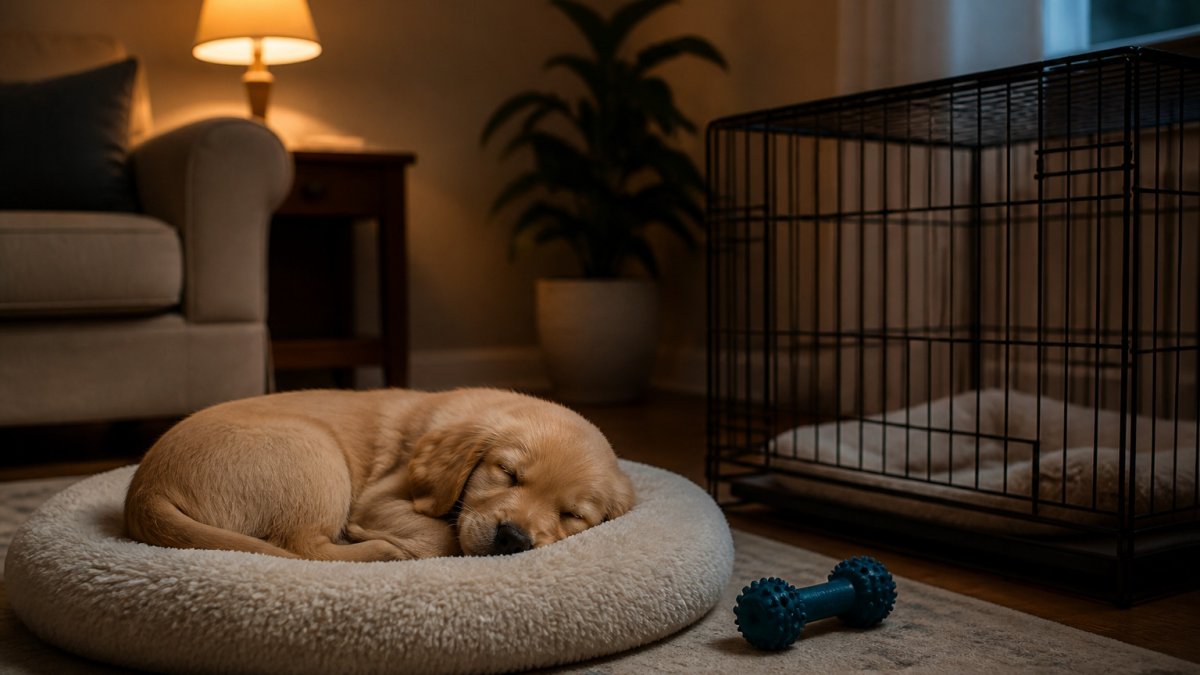
A crate can make that spot feel safe. Set it up with a soft bed, a chew toy and a blanket, and keep it near your bedroom at first. Many owners find that a steady bedtime routine helps their puppy settle faster over the first few weeks.
Our guide The Calm Dog Guide walks through a simple settle routine you can follow at night.

How to Calm a Puppy Down From Biting
Biting usually comes from overexcitement or a need to chew. When your puppy nips, stop moving, say a calm word and offer a chew toy instead of your hand or sleeve. Once it stops biting, give praise or a treat.
Consistency matters most. Everyone in the house should respond the same way, every time.
Teaching a Settle Cue and Building a Calming Home Schedule
A settle cue works best when it is built in short, easy stages rather than introduced all at once. The goal is a puppy that lies down on cue and stays relaxed while life happens around it.
Stage 1, Capture the position (days 1 to 3). Wait for your puppy to lie down on its own, then calmly say "settle" and place a small treat between its front paws. Do not lure or push the puppy down; you are naming a behavior it already offers.
Stage 2, Add duration (days 4 to 7). Once the puppy lies down within a few seconds of hearing the cue, start delaying the treat. Reward after two seconds, then three, then five. Build to about ten seconds of calm lying before the treat. If the puppy pops up, shorten the delay rather than repeating the cue.
Stage 3, Add distance and distraction (week 2). Practice while you stand a step away, then two steps, then while you sit on the couch. Add mild distractions, a toy on the floor, a person walking past, one at a time. Move to the next step only when the puppy succeeds at the current one consistently.
Stage 4, Use it in real life (week 3 onward). Give the cue before meals, during TV time, and when visitors arrive, always paired with a chew or lick mat so the puppy has something to do while lying down. Keep sessions under five minutes and end on a success.
Common mistakes to avoid:
- Repeating the cue over and over while the puppy is aroused; say it once, wait, and reset if needed
- Rewarding only the lie-down and not the relaxed body; treat when the puppy's head is down and its body is still
- Practicing only when the puppy is already exhausted, which teaches nothing about settling under mild arousal
- Using the cue as a punishment or a way to end all fun, which makes the puppy avoid it
A calming home schedule works best when it is predictable and built around naps, not just play. Puppies need a lot of sleep, so the schedule should protect rest as firmly as it protects exercise.
A sample weekday schedule:
- 7:00 a.m. Potty break, breakfast, short sniff walk
- 8:00 a.m. Brief training session, then crate or pen for a nap
- 10:30 a.m. Potty break, scatter feed or snuffle mat
- 11:00 a.m. Quiet chew time, then nap
- 1:00 p.m. Potty break, gentle indoor play or a second short walk
- 2:00 p.m. Settle cue practice, then nap
- 4:30 p.m. Potty break, enrichment toy or lick mat
- 5:30 p.m. Dinner, calm play, short training
- 7:00 p.m. Wind-down: dim lights, chew toy, settle cue
- 9:30 p.m. Final potty break, bedtime in crate or pen
Adjust the times to your household, but keep the order the same. The sequence, potty, food, activity, enrichment, rest, is what teaches the puppy what comes next. Track progress by noting how long your puppy stays settled after the cue, and expect gradual improvement over several weeks of daily practice.
For a step-by-step plan on crate setup and training, see Crate Training in 7 Days.
Your Next Step: Start a Calm Routine Tonight
Start small tonight with your calm high-energy puppy. Dim the lights, offer one sniffing game, take your puppy out to potty and set up a quiet resting spot. Keep the routine the same each day so your puppy learns what comes next.
If your puppy's energy or biting seems extreme, or it stays unsettled for long periods, talk with your veterinarian or a qualified dog trainer. For a complete first-month plan covering socialization and daily structure, see Puppy's First 30 Days. Our Happy Dog Bundle brings together the guides you need to start now, and you can order it today.


Frequently Asked Questions
How do I calm my puppy down at night?
Start the evening wind-down about an hour before bedtime. Stop vigorous play, dim the lights, and offer a short sniffing game or a lick mat to encourage rest. Take the puppy outside for a potty break, keep the house quiet, and place them in a crate or quiet space near your bed. A consistent sequence every night helps the puppy recognize that it is time to sleep, and most puppies settle faster within a few weeks of the same routine.
How do I calm a puppy down when it is biting?
Stop the play immediately when teeth touch skin, and calmly withdraw your hand or toy. Redirect the puppy to a chew toy and reward them when they chew it instead. Biting often spikes when a puppy is overtired, so a short rest in a quiet space can help. Avoid rough wrestling games, which tend to escalate biting. Be consistent with every family member so the puppy learns the same rule everywhere.
How can I tire out a high-energy puppy at home?
Use short, low-impact activities suited to the puppy's age, such as hide-and-seek, scatter feeding in a snuffle mat, or a few minutes of gentle fetch on a carpeted floor. Sniffing games are especially effective because they tire the brain as well as the body. Keep sessions brief, since young puppies can be overtired by long play. Follow each active period with a rest so the puppy learns to settle afterward.
How can I teach my puppy to settle at home?
Pair a cue word such as 'settle' with a mat or bed. Reward the puppy each time they lie down calmly, starting with a few seconds and gradually extending the time. Increase distance and distractions slowly, and use a calm verbal encouragement in a soft voice. If progress stalls or the puppy seems unusually anxious, consider speaking with your veterinarian or a qualified trainer.
